Ukraine Fights Russian Troops Inside Old Soviet Gas Pipeline
Ukrainian forces have been fighting Russian troops inside a narrow Soviet-era gas pipeline in the Kharkiv region for seven months, marking a new underground front in the war.
By Julian Lee ·
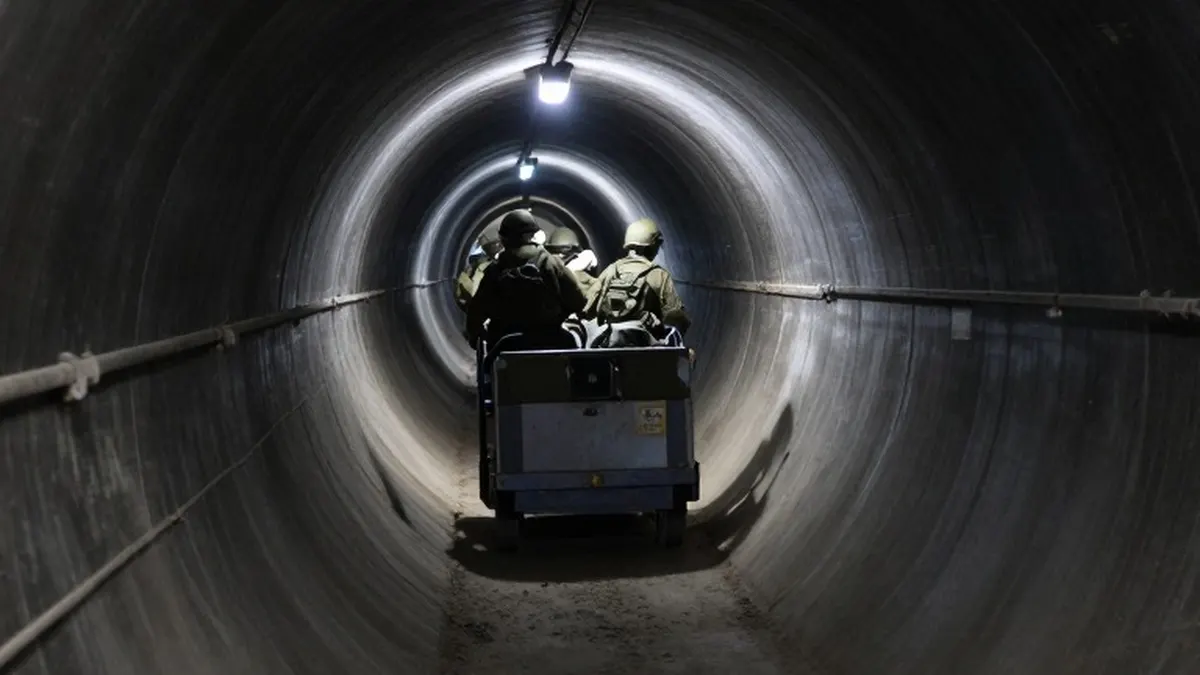
A new and unconventional front has emerged in the war in Ukraine, shifting the battleground beneath the earth. For the past seven months, Ukrainian forces have been living and engaging Russian troops inside an old Soviet-era gas pipeline in the northeastern Kharkiv region. The tunnel, which has a diameter of just over a meter, is so narrow that soldiers must crawl to move, yet it offers a significant tactical advantage. The confined space provides relative safety from the drones that currently saturate the airspace above the front line, making surface advances nearly impossible for either side.
Zanuda, who helped plan the tunnel operation, describes this subterranean conflict as a new world of fighting. While he acknowledges the difficulty, he notes that it is now the only viable option. He explains that on the surface, troops have room to maneuver, but underground, engagement with the enemy is strictly head-on. The journey to the tunnel entrance is itself dangerous, requiring a high-speed vehicle move across open fields followed by a long march through muddy terrain. Ukrainian troops accompany the movement with weapons loaded, ready to shoot down Russian drones.
Upon arriving at the tunnel entrance, the lingering smell of gas and fetid air is immediate. Both sides use openings in the pipeline to access the surface, where most of the fighting occurs. They have breached the ground and used welding tools to break through the thick steel. The Russian forces were the first to exploit this infrastructure, using it to infiltrate the nearby city of Kupyansk in September 2025. Russia has previously utilized underground pipelines during the capture of Avdiivka in 2024 and in its attempts to recapture areas of the Kursk region. However, Ukrainian forces have gradually turned the tables on this tactic.
A specially designed electric cart, dubbed the Kupyansk metro, now transports troops and supplies through the pipeline. The ride lasts approximately 40 minutes, with passengers keeping their heads bowed and legs crossed to avoid the low ceiling. The cart occasionally breaks down, and riders experience regular bumps when crossing welded sections of the pipe. The destination is a break in the pipeline where Ukrainian troops have built dug-outs to store ammunition and equipment. There, a soldier known as Musician conducts the movement of troops and supplies. He has been living underground for three months, with only brief visits to the surface to clean up or use the toilet. He notes that while they are close to the line of contact, it is safe underground.
The cart continues its journey into the depths of the earth and returns about half an hour later with more troops covered in dirt from surface positions. Vovochka, who has been fighting on the ground for the past three weeks, says it is more comfortable in the pipe because drones, artillery shells, and glide bombs do not reach that level. Despite the relative safety, fighting has occurred within the pipeline itself. Operation Veles, named after a mythical Slavic god of the underworld, began in April. Since then, Ukraine has advanced 15 kilometers along the pipeline. This has been painstaking and backbreaking work, marked by the constant fear of enemy contact.
Above ground, soldiers from the 13th Khartiia Brigade of Ukraine's National Guard describe the initial challenges of the mission. Their first task was to clear debris, water, and Russian barricades inside the pipeline. Some of these barriers were boobytrapped or piled with Russian bodies. Chyzh, a member of the unit, recalls that when they moved or climbed over the barriers, they had no idea what lay underneath. Another major danger was the unpredictable ricochets of gunfire as they tried to advance. Kort, a comrade, stated that they were all firing and pushing the enemy back. Ukraine says it killed more than 100 Russian soldiers and took 30 prisoners during the operation. Kort admitted that there were bodies inside the pipe and that he even had to sleep next to them.
The commander of the unit, Biashym, whose former life as a miner prepared him for the physical and psychological challenges of operating underground, keeps in regular contact with his men from a surface building. Behind him is a cabinet full of medicine. Soldiers in the pipeline spend much of their time on their knees, suffering from abrasions. Biashym admits that some have experienced panic attacks due to the confined space, while others have struggled to breathe. Hundreds of Colombian volunteers, part of the RUG 23rd Assault Regiment, have also been involved in the operation. One volunteer, who goes by the call sign Gecko, noted that it took 30 days to clear just 500 meters of the pipe. He described the experience as difficult and hot, with fear present inside the pipe, but eventually decided to deal with it and advance.
The battle of the pipeline is not yet over. Russian forces have also built fortified positions inside the pipeline and continue to try to infiltrate Ukrainian positions by burrowing in and out. From a control room above ground, Ukrainian drones have been used to target another Russian attempt to outflank them. While some fighting takes place underground, there are still battles on the surface and in the air, making this a combined operation. Zanuda believes this underground method is the best way to fight in the future. He stated that ground operations are now nearly impossible and that everyone understands, for now, the only way to fight is underground. He added that more missions like this are likely because pipelines run everywhere, recalling that in Soviet times, oil, gas, and ammonia were transported to Europe with transit routes running through Ukraine.
In reality, the work has been brutal, gruelling, and dangerous in the harshest of conditions. It took Ukraine seven months to clear 15 kilometers of the pipeline. President Volodymyr Zelensky has hailed the operation as a success. While it has helped retake lost territory and boosted morale, it has not, on its own, changed the course of the war. Additional reporting for this story was provided by Moose Campbell, Volodymyr Lozhko, and Rebecca Hartmann.