Ukraine's Most Destructive Strike Yet Leaves Crimea Bridge Road Span in the Kerch Strait
A two-day missile and drone assault has dropped more than 200 meters of the Crimea Bridge's roadway into the sea, leaving Russia dependent on rail traffic and a coastal highway exposed to Ukrainian drones.
By Julian Lee ·
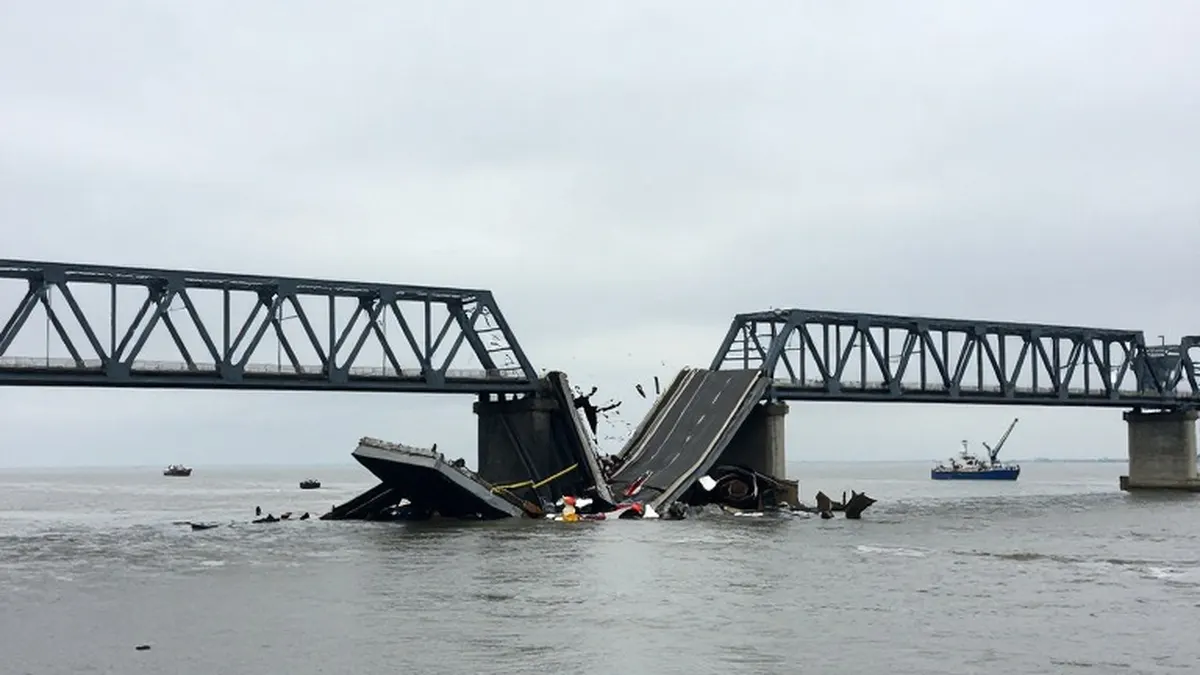
Ukraine has delivered its most damaging blow yet to the Crimea Bridge, the $4 billion engineering showpiece that has anchored Moscow's hold on the peninsula since Russia occupied it in 2014. A missile and drone attack carried out in several waves on November 16 and 17 sent more than 200 meters of the structure's road span into 9 meters of water, scattering an asphalt-and-steel debris field across the Kerch Strait shipping channel.
Only the road span was destroyed. Rail traffic across the 19-kilometer crossing has resumed, though the extent of service remains unclear. The bridge, sometimes called the Kerch Bridge, was completed in 2018 and inaugurated by President Vladimir Putin, who personally drove a heavy truck across it. Until Russia's full-scale invasion in February 2022, it was the only direct land route for people and supplies between the Russian mainland and Crimea. The war reaches its fifth anniversary in February.
Experts say this strike stands apart from earlier attempts, which included a 2022 truck bombing orchestrated by Ukrainian military intelligence that was repaired in under five months, and a 2025 underwater drone hit that caused little structural damage. "I think the damage is quite significant," said Brian Clark, a former US naval officer and naval operations expert at the Hudson Institute. "This damage looks as though it may have compromised the structural integrity of the bridge." Sam Rigby, an engineering professor at the University of Sheffield, called the attack "markedly different" because it targeted a much larger span of considerably higher structural complexity. Ukrainian aviation engineer Konstantin Kryvolap told Current Time the strikes hit the bridge's weakest points, the connecting elements where its arches are attached.
Ukraine's military command said Russia had built a myth around the bridge as a symbol of Crimea being "Russian forever," adding: "Now part of the structure lies underwater." Kremlin spokesperson Dmitry Peskov vowed the bridge would be rebuilt "even better than before."
The destruction sharply raises the stakes for supplying Crimea's 2 million residents and the hundreds of thousands of Russian military personnel based there. Since earlier this year, Ukrainian forces have ramped up a so-called middle strike drone campaign against cargo trucks and some train traffic on the M-14 coastal highway, the overland route Russia consolidated after capturing Mariupol in the spring of 2022. With the road span gone, trains alone will carry people and goods to and from the peninsula for the foreseeable future. Israeli military expert David Gendelman said diverting traffic to the M-14, which can only handle so much civilian and military volume, will slow and complicate logistics, making it harder to supply Russia's entire southern grouping. Ukrainian forces reportedly compounded the problem on November 17 by damaging another major bridge providing a direct road link between Crimea and Rostov-on-Don, a key military staging ground, via the port of Taganrog.
Repairs will not come quickly. Kryvolap said the work cannot be done in less than six months and will most likely take more than a year. David MacKenzie, a senior technical director with the British engineering consultancy COWI, said a new span would have to be assembled on the shoreline of the Sea of Azov, then floated to the site and lifted into place, because the railway bridge blocks transport of a complete span from the Black Sea. That entire coastline lies within 300 kilometers of Ukrainian-held territory, leaving any monthslong fabrication project exposed to drones and missiles.
Clearing the wreckage blocking the strait could take a week or two if weather and Ukrainian threats permit, MacKenzie said, but the Kremlin must choose between restoring maritime or road traffic first, since temporary road access cannot coexist with shipping access. Mike Petersen, a former senior US naval adviser with the Center for Naval Analyses, cautioned that Ukraine could contest every salvage attempt and extend the closure almost indefinitely, noting it took US authorities 76 days to clear the channel after Baltimore's Francis Scott Key Bridge collapsed in 2024. Still, he said the overall shipping impact will be limited because Russia had already rerouted much of its traffic to the Baltic Sea and the Pacific in response to Ukrainian attacks, a shift that has made the Asia Pacific region far more critical to Russia's economic interests.
On Crimea itself, the attack triggered scattered panic buying at grocery stores and lines at fueling stations, reviving memories of summer shortages severe enough that local authorities imposed a coupon-rationing system for gasoline. In a video posted to Instagram, a woman identified as Vlada Ilyinichna vented at the queues and food hoarding, while another resident, Viktoria Baturinakazbanova, reported lines at some stations but "nothing critical," saying food prices were unchanged and residents were confident the new span would be more beautiful and stronger than the old one. Bad weather forced the cancellation of all ferry traffic across the strait on November 18, authorities said.