Kyiv Residents Shift to Subterranean Life as Strike Toll Rises
With 140 deaths recorded in the first eight months of 2026, the Ukrainian capital faces its deadliest period since 2022 as infrastructure failures disrupt daily commerce and heating.
By Julian Lee ·
The economic stability of Kyiv is fracturing under the weight of intensified Russian military strikes that have transformed the capital into a primary target zone. The shift is visible in the city's daily operations, where residents now rely on subway stations for shelter and commercial supply chains face disruptions not seen since the early days of the conflict.
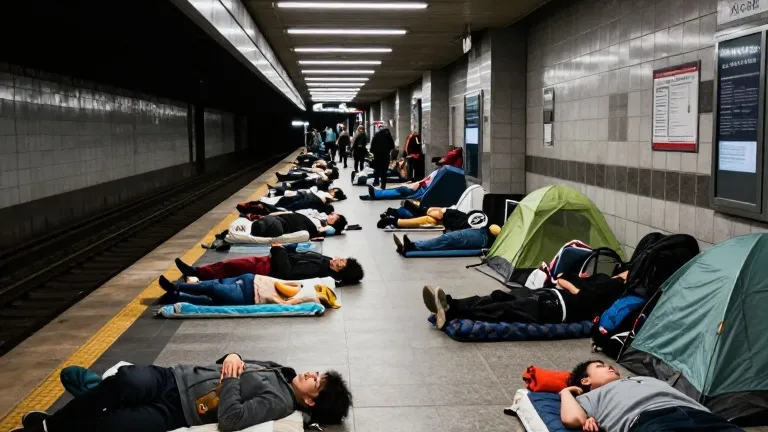
Housing deficits have forced a structural change in where millions of people sleep. With insufficient dedicated shelters for the city's four million inhabitants, residents use metro stations as overnight accommodations. From approximately 10 p.m. each night, individuals lay out mattresses and erect small tents. The practice includes children and pets, who settle along the cold walls of the underground infrastructure.
Halyna, a resident of the Lukyanivka district, takes her five-year-old son, Roman, to the nearest station on most evenings regardless of siren status. Her neighborhood has been a repeated target during the four years and eight months of the war. She described the routine as a survival mechanism, stating, "We're alive," and adding, "We've been lucky once again." Her decision reflects a widespread precautionary behavior among families in districts with a history of drone attacks.
The human cost of these strikes is accelerating. Kyiv's military administration reports that 140 people were killed in the capital during the first eight months of 2026. This figure exceeds the 172 total deaths recorded for the entire year of 2025. If the current pace continues, 2026 is projected to be the deadliest year for the city since the full-scale invasion began in 2022.
Recent incidents have targeted residential and educational structures. In September, a Russian drone struck an apartment building in the central Pechersk district, killing 14-year-old Daniel Umanskyj. A neighbor, Vlad, was in the hallway with his daughter at the time. He noted that being delayed that evening saved their lives, describing the attackers as "sick monsters" who do not distinguish between targets. In early October, a drone hit a school building in southwestern Kyiv. Principal Valentyna Chorna said the institution continues in-person instruction for grades one through nine because its shelter capacity exceeds 500 students.
Supply chains are under pressure from attacks on storage facilities. Russian strikes on warehouses have created supermarket shortages comparable to those in the war's initial months. The energy sector is also vulnerable. Emergency power outages returned at the end of September, and a specific attack temporarily disabled the subway network. These infrastructure hits create uncertainty regarding the city's ability to maintain reliable heat, electricity, and water services through the winter season.
Administrative efforts aim to normalize routines despite the physical risks. Authorities shortened the curfew to a four-hour window from 1 a.m. to 5 a.m. Some facilities are permitted to operate during "yellow" alerts, which indicate a threat of drone attacks. During "red" alerts, which signal ballistic or cruise missile threats, residents must take shelter immediately. The Kyiv International Institute of Sociology reported in early October that 72% of residents said in September they were prepared to endure the war for as long as necessary.
More Business · World news · Business Watchdog · Report a business · Got a Story?