
Israeli Knesset elects opposition ally as new speaker
Matan Kahana wins the speakership in a move that strengthens the hand of Gadi Eisenkot's bloc as it works to form a new government and reverse controversial policies.
By Julian Lee ·
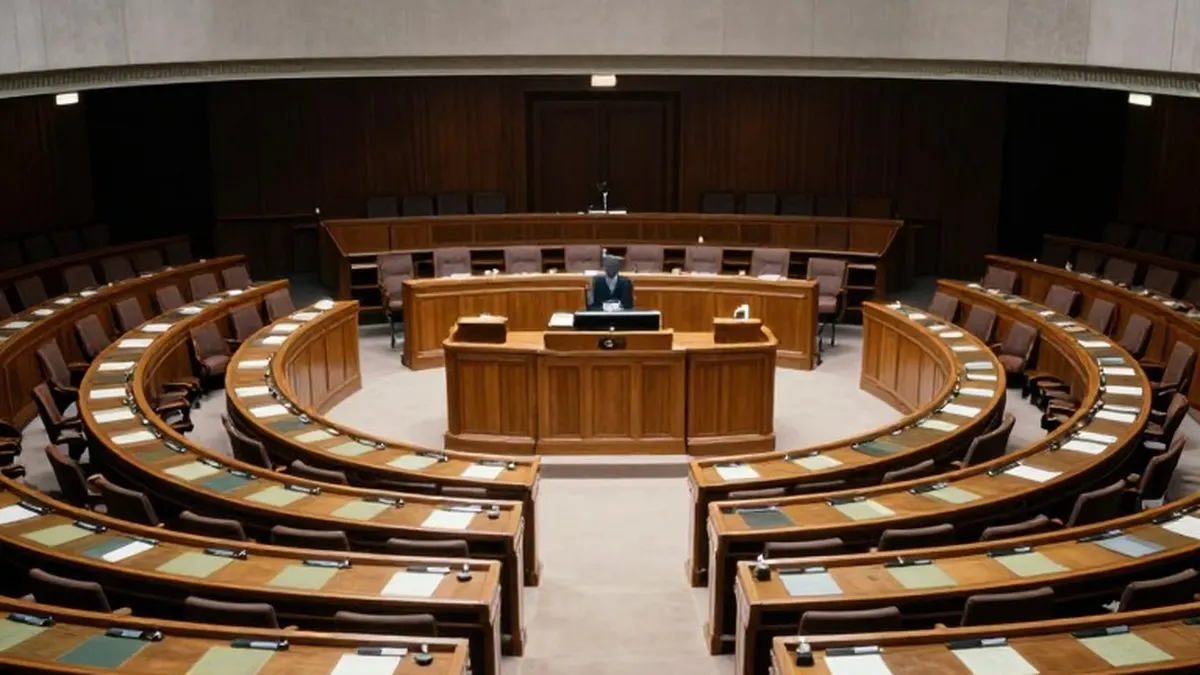
The Israeli parliament elected a new speaker on Tuesday, a significant procedural step that empowers the opposition to begin rolling back policies enacted by the outgoing government of Prime Minister Benjamin Netanyahu. The winner of the election is Matan Kahana, a political ally of Gadi Eisenkot. Eisenkot is the party leader currently tasked with forming the next coalition government to replace Netanyahu.
Kahana secured the position with 66 votes in the 120-member chamber. His victory was supported by the Jewish-led opposition parties as well as the Arab-led parties. In contrast, Ofir Katz, the candidate backed by Netanyahu's bloc, received 52 votes. The decision came after a contentious debate that lasted more than seven hours.
Gadi Eisenkot described the outcome as a worthy democratic move that reflects a clear majority in favor of change. His political bloc has pledged to undo several of the most contentious policies implemented during Netanyahu's tenure. This development follows the parliamentary elections held on October 27, in which Netanyahu and his allies lost their majority in the legislature. Following those results, Israel's president assigned Eisenkot the responsibility of attempting to form a new coalition.
Eisenkot has a limited window of five additional weeks to secure the necessary alliances to form a stable government. While these negotiations continue, his bloc, along with unaffiliated Arab-led parties, can utilize their majority in the newly sworn-in Knesset to advance their legislative agenda. Last week, these parties introduced several bills. These proposals include establishing term limits for the prime minister, creating a government-led inquiry into the Hamas-led attacks of October 7, 2023, and reversing laws that restrict the powers of the judiciary.
Assaf Shapira of the Israel Democracy Institute, a Jerusalem-based think tank, noted that Kahana's election provides the opposition with a major legislative advantage. He explained that the speaker of the Knesset has the power to significantly accelerate or slow down the legislative process. This control is particularly important given the limited time available for the new bloc to act.
Kahana replaces Amir Ohana, who had served as speaker as an ally of Netanyahu. Eisenkot and his allies are now under pressure to quickly advance their legislative priorities. Roy Folkman, a member of Eisenkot's Yashar party, currently heads the temporary committee that determines much of the Knesset's work until a formal government is established.
If Eisenkot fails to form a government within the allotted time, the Israeli president may grant Netanyahu an opportunity to do so. Such a scenario would likely give Netanyahu's Likud party control of the temporary committee. Although the opposition would still hold a numerical majority, Shapira warned that they would feel their momentum had diminished. He noted there is a real danger that some legislation could be delayed in that event.
Chamber procedures also pose challenges for the new bloc. A bill must be introduced on the floor, considered in committee, and voted on multiple times before it can pass. This complex process makes it difficult to complete legislation before the deadline. Shapira suggested that Eisenkot and his allies will likely prioritize rolling back controversial laws that expanded the government's role in appointing judges and weakened the power of the attorney general. He stated that it is very easy to abolish these laws because no new institutions need to be created.
Shapira added that establishing a body to investigate the October 7 attacks would be relatively easy and would carry greater legitimacy once a government is formed. Netanyahu's opponents argue that he has blocked an independent probe into military or intelligence failures related to that day, which was the deadliest in Israel's history. They maintain that this has allowed him to evade accountability.