Hegseth Orders Third Carrier to Region as Iran Demands Control of Strait
Military buildup coincides with a surge in early voting, creating a strategic dilemma for Washington ahead of the November 3 midterm elections.
By Hannah Takahashi ·
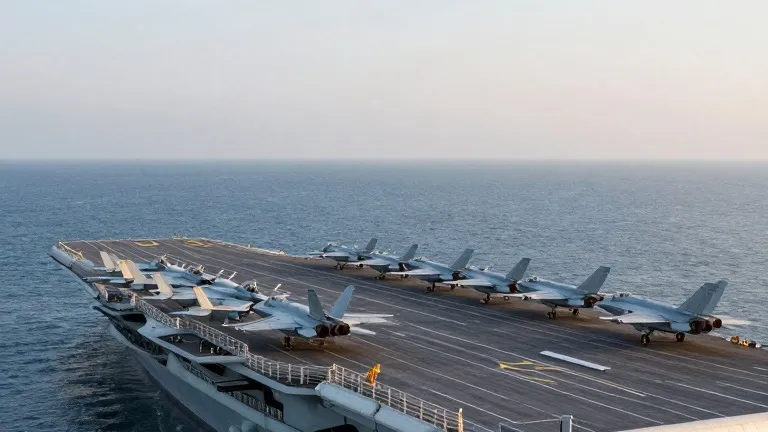
The United States is deploying its third aircraft carrier to the Middle East, a move that signals preparation for potential conflict with Iran in the weeks following the November 3 midterm elections. A person briefed on U.S. and Israeli war planning told NPR that the two nations are coordinating for a possible attack after the vote concludes. Iranian Foreign Minister Abbas Araghchi stated that his country is ready for both diplomacy and war, though Tehran has shown no sign of making major concessions.
Defense Secretary Pete Hegseth recently traveled to Israel to meet with Prime Minister Benjamin Netanyahu, reinforcing the impression of heightened military coordination. President Trump is expected to weigh military action only after Election Day to avoid a spike in oil prices before voters cast their ballots. Iran is demanding formal control of the Strait of Hormuz and the withdrawal of U.S. troops from the region, conditions that complicate the diplomatic track.
The timing of the deployment coincides with a surge in early voting across the United States. According to the University of Florida's Election Lab, nearly 21 million Americans have cast ballots by mail or in person, with that total rising by about 2 million in a single day. Early voting in key battleground states is currently higher than during the previous midterm cycle. However, analysts caution against interpreting these figures as a forecast of final results, noting that Democrats typically vote early while Republicans often wait until Election Day.
Domestic political dynamics are intersecting with the military buildup in other ways. A federal judge in California is restricting pre-election field operations by the Department of Homeland Security, which aims to identify noncitizens who allegedly voted illegally in nine states. Separately, a federal magistrate judge ruled that President Trump must sit for a deposition in his $10 billion defamation case against the BBC. The suit centers on a Panorama broadcast from late October 2024 that allegedly edited his January 6 speech. Trump has previously canceled a scheduled deposition, citing matters of national importance, and proposed January as an alternative date.
Economic pressures from the regional conflict are also affecting household budgets. While some items have become cheaper, overall grocery prices have risen due to higher labor costs, tariffs, and energy prices linked to the Iran conflict. Ground beef reached $6.79 per pound last month, an 85% increase over the past decade, according to the Bureau of Labor Statistics. Conversely, eggs fell to $2.27 per dozen after a record high of $6.23 in March 2025, and butter averaged $3.96 in September, down 17.3% from a year earlier due to oversupply. Coffee remains 44% higher than two years ago despite the removal of tariffs on the product.