Moscow shares missile data as Pyongyang scales drone output
South Korea responded to North Korea's 700 km test by firing its first hypersonic missile, marking a shift in the regional standoff.
By Sofia Suzuki ·
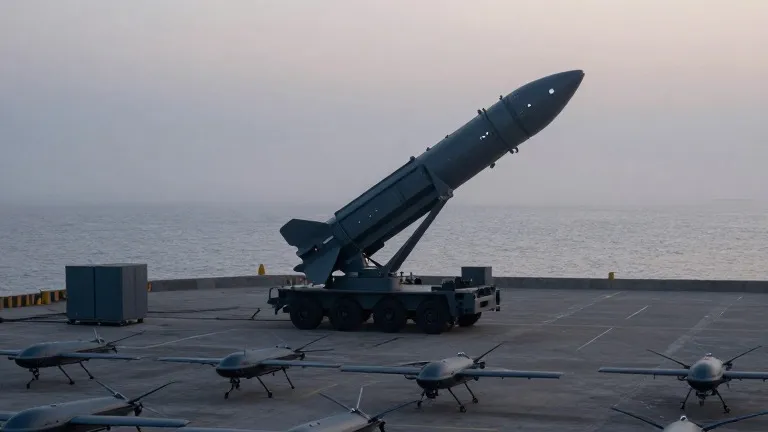
South Korea test-fired a hypersonic ballistic missile five days after North Korea launched a tactical missile, a response that signals growing alarm in Seoul. The North's projectile, which Pyongyang claims can carry a nuclear warhead, traveled approximately 700 km according to estimates from South Korea and Japan. North Korea stated the range was 1,000 km.
President Lee Jae Myung observed the South Korean launch, which marks the first time the country has tested such a weapon. This move departs from Seoul's historical practice of issuing brief statements describing North Korean tests as provocative. The rapid advancement of Pyongyang's missile technology has prompted a more tangible military reply.
According to a report by The New York Times, North Korea has begun mass-producing attack drones with technical assistance from Russia. Moscow is providing military developments to Pyongyang in exchange for soldiers, workers, and weapons. This cooperation has intensified since Russia began its full-scale invasion of Ukraine in 2022, leading to a renewal of military ties between the two nations.
Analyst Anton Ponomarenko stated that access to Russian deployment data and feedback has improved the accuracy and maneuverability of North Korean weapons. He described the resulting threat to South Korea as more substantial. The New York Times noted that North Korea has observed how inexpensive drones can overwhelm costly air defense systems in Ukraine and the Middle East.
In a drill conducted last month, a North Korean drone swarm attacked a target island while cruise and ballistic missiles struck simultaneously from different directions. The newspaper argued that these evolving tactics will force South Korea and its allies to redesign their air defenses at significant cost. This development follows Bloomberg's September report that up to 25,000 North Korean citizens are working at Russian military plants, including facilities in Alabuga, Tatarstan, to produce drones.
A North Korean missile forces unit, capable of fielding 120 ballistic missiles and six launchers, has begun deploying in western Russia for potential strikes against Ukraine. In June 2026, North Korea announced tests of a modernized 240mm multiple-launch rocket system, a tactical ballistic missile, and a 155mm long-range artillery shell. Russia also requested KN-30 ballistic missiles from Pyongyang in August.