Israel Flattens Hebron Homes as Netanyahu Promises Historic West Bank Operation
Mass evictions follow a checkpoint ambush that killed two soldiers, with analysts linking the military response to a tight national election four days away.
By Sofia Suzuki ·
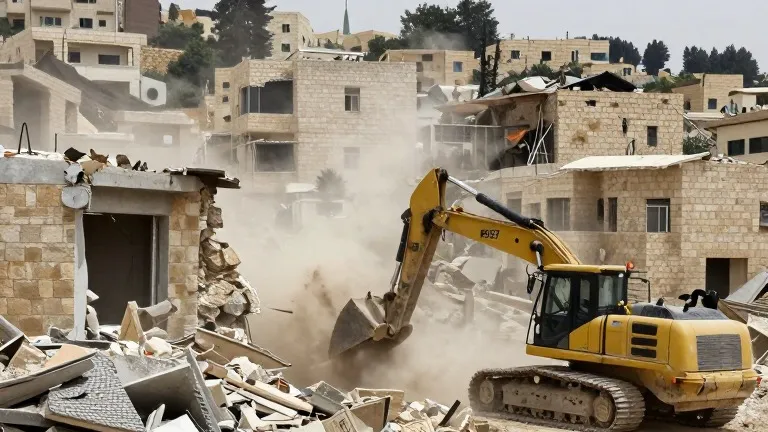
Hundreds of Palestinian families are being forced from their homes in Hebron as Israeli bulldozers flatten structures near the site of a deadly ambush. The destruction began on Friday afternoon, displacing residents in one of the most populous cities in the occupied West Bank. These actions mark the start of a major military campaign that Prime Minister Benjamin Netanyahu has promised will match the scale of Israel's initial occupation of the territory in 1967.
The military response was triggered by an attack on a checkpoint near Hebron where two gunmen opened fire on soldiers behind concrete barriers. A firefight lasted approximately 20 minutes until troops killed the attackers. The incident left two soldiers dead and three others wounded. Netanyahu addressed the nation from the attack site, stating, "We will act to demolish this place, to change it completely."
Netanyahu compared the upcoming operation to last year's assault on two refugee camps in the northern West Bank. That previous campaign displaced tens of thousands of people and led Human Rights Watch to claim the expulsions constituted war crimes. Israel rejected that assessment. B'Tselem, an Israeli human rights group, has urged foreign governments to intervene to stop what it calls a new wave of ethnic cleansing.
Political observers connect the aggressive military posture to Israel's national elections scheduled for October 27. Current polls show Netanyahu and his rival, Gadi Eisenkot, in a dead heat, with neither candidate holding enough support to form a government. Danny Citrinowicz, a senior researcher at the Institute for National Security Studies in Tel Aviv, noted that Netanyahu is positioning himself as the country's primary security figure. "For Netanyahu, his ticket before the election is, 'I'm Mr. Security,'" Citrinowicz said. He argued that harsh measures are intended to demonstrate protection to the Israeli public.
Many analysts view the operation as a strategy to maintain political power rather than a long-term security improvement. Citrinowicz described the eviction of families from the attackers' neighborhood, despite a lack of evidence linking them to the gunmen, as collective punishment. He suggested that preventing future attacks requires giving hope rather than punishing communities, urging authorities to arrest specific threats while supporting a stable economy for residents who seek peace.