
Black Holes Above 100 Billion Suns Cannot Fill Dark Matter Gap
Physicists in Germany and Abu Dhabi find the early universe's light lacks the blotches that such objects would produce.
By Hannah Takahashi ·
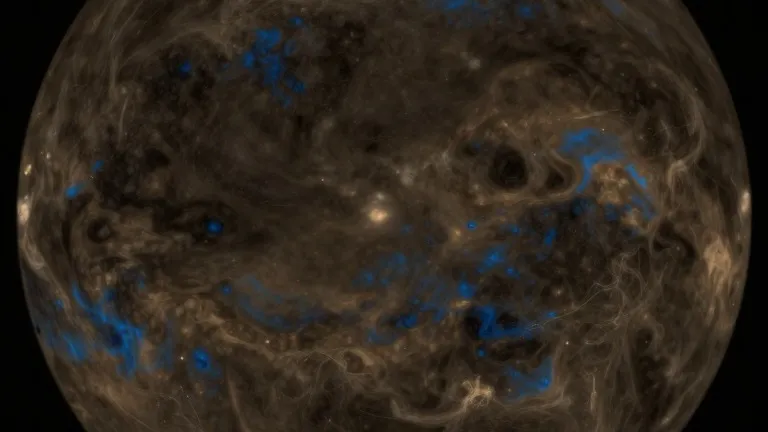
Black holes weighing more than 100 billion suns cannot supply a major share of the cosmos's missing mass, according to an analysis published on Oct. 23. The work is due to appear in Physical Review Letters on Oct. 26.
Dark matter accounts for about five-sixths of all matter, a figure inferred from the speed at which galaxies turn. Astronomers have never detected it directly. Christopher Gerlach, a theoretical physicist at the Mainz Institute for Theoretical Physics in Germany, said dark matter is often pictured "as a fine dust spread everywhere." Concentrated instead in a handful of giant objects, he said, "the universe becomes grainy on very large scales. And we can check that."
The check used the cosmic microwave background, the radiation released once the early universe cooled enough for atoms to form and light to move freely. That light reached the sky 380,000 years after the Big Bang. Gerlach described it as "a snapshot of the infant universe covering the whole sky." Antonio Iovino, a theoretical physicist at New York University Abu Dhabi, said the temperature of that light "varies from place to place by about one part in 100,000."
The team looked for patches in that pattern. Black holes heavier than 1 trillion to 10 trillion suns, a range that outweighs whole galaxies, would have left coarse clumps. No such clumps appeared. "So these black holes can't be a significant part of the dark matter," said Nicholas Leister, a theoretical physicist at the Mainz Institute for Theoretical Physics.
No object of that scale has been found. Surveys of many galaxies have turned up none, and the heaviest black hole on record holds about 36 billion suns. The authors said the result does not rule out the existence of very large black holes, only their role as a main reservoir of dark matter. They are now testing asteroid-mass black holes, which remain a candidate for the missing matter, for the same reason.
Gerlach and Iovino worked with Leister and other researchers on the analysis.